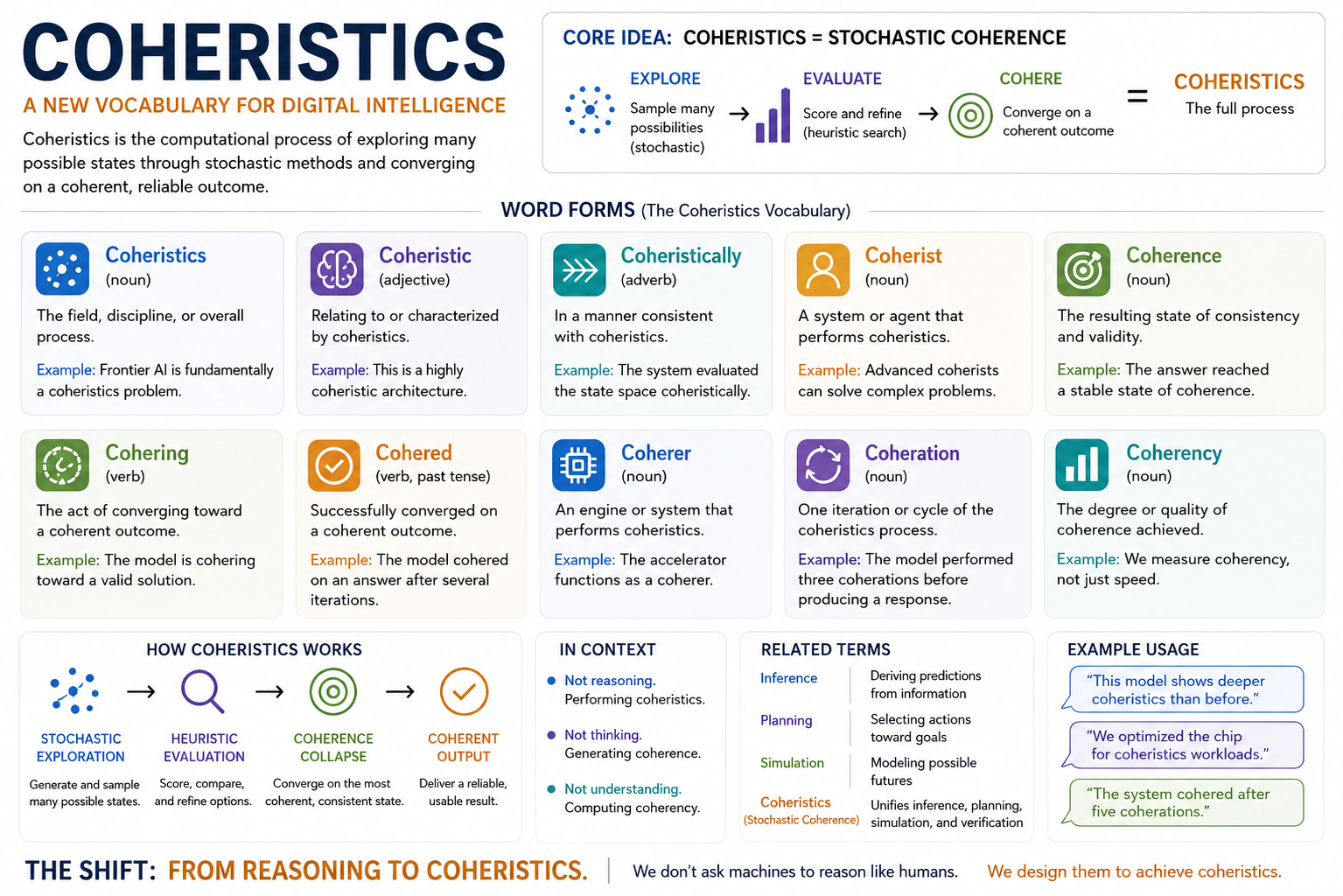
Coheristics is the computational process of achieving coherence through stochastic exploration, evaluation, and convergence.
A new vocabulary for digital intelligence
Coheristics
A machine-centric language for systems that explore possible states, evaluate constraints, and converge on coherent outcomes.
Stochastic exploration
+
Coherence formation
=
Coheristics
Definition
From reasoning to coheristics.
For decades, advanced computational systems have been described as “reasoning.” The term is useful, but it carries assumptions inherited from human cognition: thought, understanding, intention, and consciousness.
Coheristics proposes a more precise description. It is not a theory of consciousness, not a claim of intelligence, and not a human psychology metaphor. It describes process.
Foundation
Stochastic coherence.
Stochastic
The exploration of many possible states, paths, solutions, or outcomes.
Coherence
The convergence toward consistency, validity, usefulness, and fit.
Coheristics
The broader vocabulary and process built on stochastic coherence.
How it works
Explore, evaluate, cohere, output.
Step 01
Exploration
A system samples many possible states through prediction, search, simulation, or hypothesis generation.
Distinction
Coheristics gives computation its own language.
Reasoning
Human-centric term
Implies cognition
Suggests understanding
Rooted in psychology
Often ambiguous
Coheristics
Machine-centric term
Describes process
Describes convergence
Rooted in computation
Explicitly defined
Vocabulary
Word forms for coherent systems.
Coheristics
nounThe discipline, field, or process of achieving coherent outcomes through stochastic methods.
Example: Modern frontier models demonstrate advanced coheristics.Coheristic
adjectiveRelating to or characterized by coheristics.
Example: This architecture is optimized for coheristic workloads.Coheristically
adverbPerformed through coheristics.
Example: The model evaluated the state space coheristically.Coherist
nounAn agent or system capable of performing coheristics.
Example: Advanced coherists can solve increasingly complex problems.Cohere
verbTo converge toward a coherent outcome.
Example: The system cohered on a valid solution.Cohered
verb, past tenseSuccessfully converged on a coherent outcome.
Example: The model cohered after multiple evaluation cycles.Coherence
nounThe resulting stable state of consistency and validity.
Example: The output achieved high coherence.Coherency
nounThe measurable quality or degree of coherence.
Example: The benchmark measures coherency rather than speed alone.Coheration
nounA single coheristic cycle or iteration.
Example: The model completed five coherations before responding.Coherer
nounA system, engine, or device that performs coheristics.
Example: The accelerator functions as a high-throughput coherer.Applications
Where coheristics applies.
FAQ
Common questions.
No. Coheristics is a vocabulary and conceptual framework for describing computational processes.
No. It makes no claims about consciousness, awareness, or subjective experience.
Not directly. The term describes computational systems without relying on anthropomorphic language.
The process of exploring possible states and converging on a coherent outcome.
Reasoning carries human cognitive assumptions. Coheristics focuses on process rather than psychology.
Reference poster
A compact vocabulary map.
The site expands the same core language into a browsable web experience for coheristics.com.